
Installing chain backwards is an easy mistake to make.
And when replacing a worn chain, simply installing the new chain in the same direction as the old one isn't necessarily the answer. The old chain may have been installed incorrectly years ago.
What makes the question more confusing is that two common types of chain found in the same sawmill can actually be designed to run in opposite directions.
Mill chains such as 78, 82, 124 and 132 generally follow one rule, while common drag chains such as 104, 110, 112 and 480 follow another.
So which end should lead?
Mill Chain — 78, 82, 124, 132 and Similar Styles
Common mill chains include 78, 82, 124 and 132, including WR, WH and H-series versions frequently found on log decks, transfers, unscramblers and other sawmill conveying equipment.
In normal conveyor service, these chains should run with the wide, open — sometimes called female — end forward in the direction of travel.
When viewed from above, the open/female end of the link points in the direction the carrying side of the conveyor is traveling.
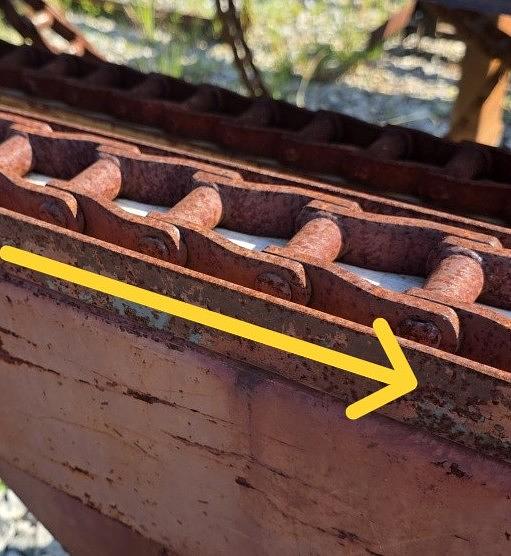
78 mill chain. The arrow shows the direction of travel.
The chain doesn't always look the same when installed on different equipment or viewed from a different angle. The important thing is to identify the open/female end of the link rather than simply deciding that the chain should run left or right.
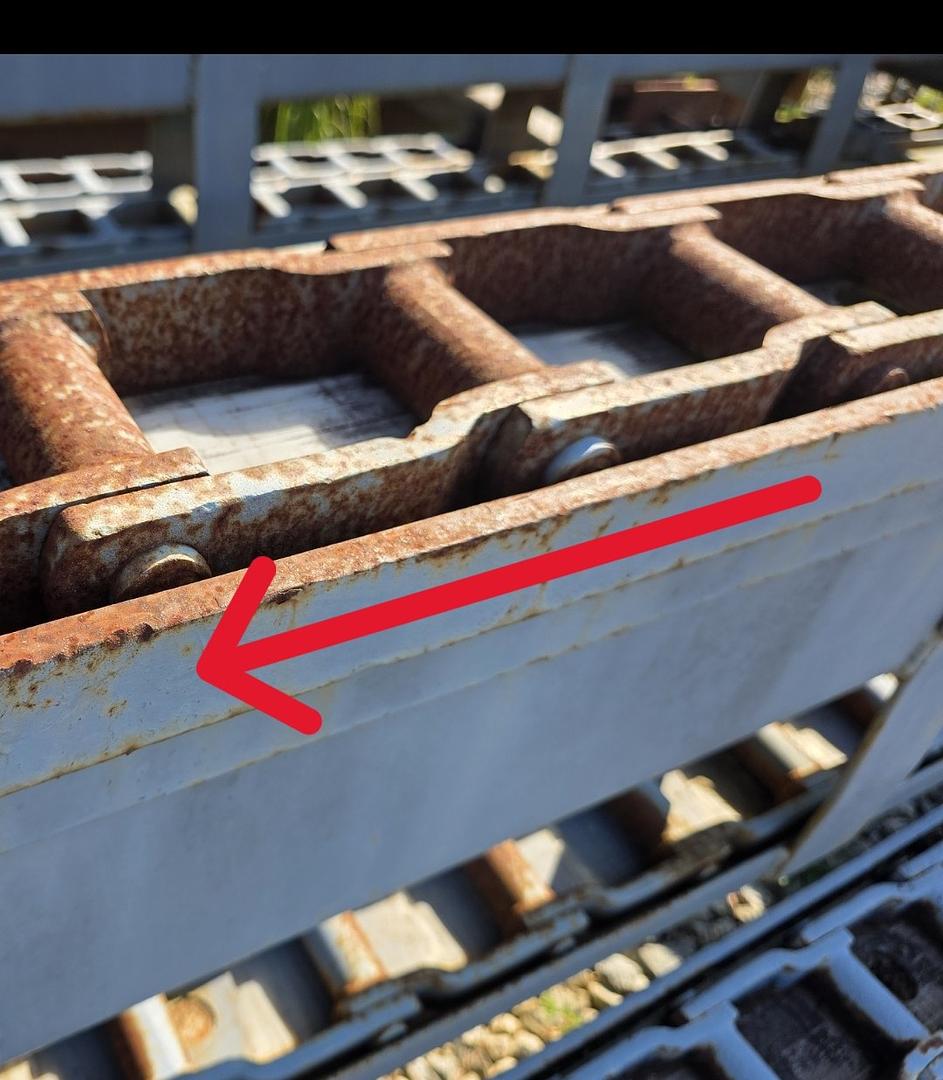
124 mill chain. Again, the open/female end leads in the direction of travel.
This gives us a simple practical rule:
Mill chain — open/female end forward.
What About Using Mill Chain as Drive Chain?
Manufacturer literature may specify the opposite orientation when some of these chains are being used as drive chain rather than conveyor chain.
In our experience, however, it is unusual to encounter these types of chains being used as drive chains in sawmill applications except in certain highly engineered, heavy-duty applications.
For the typical sawmill conveyor, deck or transfer, the rule is straightforward:
Mill chain — viewed from above on the carrying side, open/female end forward.
Drag Chain — 104, 110, 112, 480 and Similar Styles
This is where things get interesting.
Common welded-steel drag chains include 104, 110, 112 and 480. At first glance, it would be easy to assume these chains should run the same way as mill chain.
They don't.
For standard welded-steel drag chain of this type, the narrow or closed end runs forward in the direction of travel.
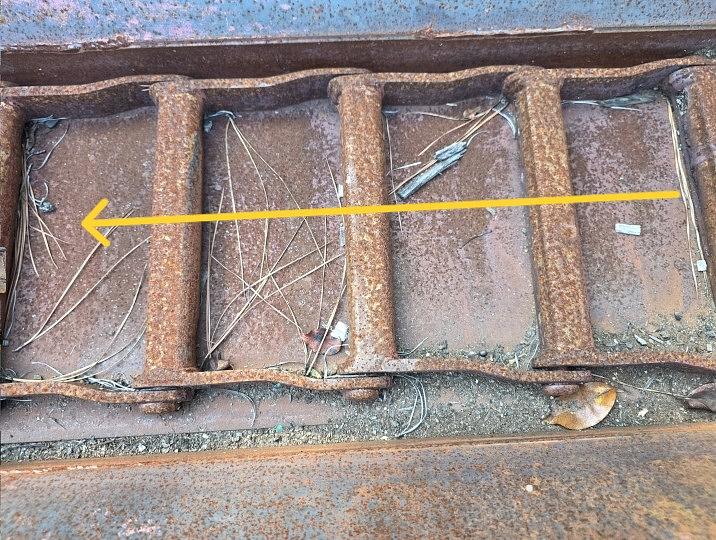
Standard drag chain. The arrow shows the direction of travel — narrow/closed end forward.
If you look closely at a typical drag-chain link, you'll notice that the barrel and the two ends of the link aren't symmetrical. That geometry affects how the chain engages and articulates around the driving sprocket.
In other words, direction of travel isn't simply a matter of appearance or preference. The chain is designed to run a particular way.
So the practical rule is:
Standard drag chain — narrow/closed end forward.
A Note About Reverse-Barrel Drag Chain
Reverse-barrel versions of some drag chains are manufactured and are designed to run in the opposite direction — open end forward.
However, this construction is rarely encountered in the sawmill and wood-products applications we see.
Unless you know you have a reverse-barrel chain, the standard direction-of-travel rule applies.
Two Chain Types — Opposite Directions
This is probably the easiest way to remember it:
Mill chain — open/female end forward.
Standard drag chain — narrow/closed end forward.
In both cases, we're describing the chain as viewed from above on the carrying side of the conveyor.
Don't Assume the Old Chain Was Right
Chains get replaced, shortened, repaired and reinstalled many times during the life of sawmill equipment. A conveyor may have been operating for years with its chain installed incorrectly.
Before installing replacement chain:
- Identify the chain number and type.
- Determine the direction of travel on the carrying side.
- Look at the chain from above and identify the open and closed ends.
- Make sure any attachments or flights are properly oriented.
- If the chain construction is unusual or you're uncertain, check the chain manufacturer's recommendation.
Heavy mill and drag chain isn't something you want to install twice.
Experience With Sawmill Material Handling
Ben Jones Machinery has worked with sawmill conveyors, decks, transfers and other material-handling equipment since 1976.
In addition to buying and selling used conveying equipment, we modify conveyors and material-handling systems to fit particular applications, including changes in width, length, height, speed, drive and power requirements.